
Group 63
- Feb 15, 2022
- 3 min read
Ironically, the best way to combat the climate emergency would be to stop building at all. This, however, is not a viable solution, but there are a series of workarounds that would still minimise our impact on the environment. The reuse of derelict buildings, either by just repartitioning them or by using their structure to build new establishments is a start. Investing in renewable energy sources and making them more accessible is another method. The developments going on in the North Sea are extremely relevant now, but recently, smaller scale interventions can be seen – as an example, using rivers to produce hydroelectric power for local communities. There is also the issue of materials, where instead of importing from far away, we could source them locally, use pre-fab materials or opt for materials with the lowest CO2 footprint. Also, at larger scales, the impact of farming on the environment could be counteracted by investment in urban farming. Ultimately, these are just a few of the ever-growing methods to combat the climate emergency, but we believe the most important “method” of all is not a method but a state of mind which starts RIGHT HERE, RIGHT NOW with whatever we have at hand!

Geothermal Energy - The Finnish Nature Centre - Lahdelma & Mahlamäki
The Haltia's heating system uses solar energy generation to create a thermally comfortable temperature during all seasons. Using energy derived from the sun and earth the building cools and heats. Additionally, the active air conditioning system reacts to the number of people in the building to ensure a thermally comfortable environment.

Ventilation - Bat Trang House - VTN Architects
The Bat Trang House is a sustainable 7-person household which makes use of locally-sourced materials. The village is famous for its ceramics production and the building acts as a testimony for this old tradition. Its sustainable features go beyond materiality, as the most iconic feature of the design is the use of natural ventilation. The system is designed in 3-layers: the doors, the greenery and the perforated walls which allow for cooling during the summer while also managing to filter the light coming into the building.
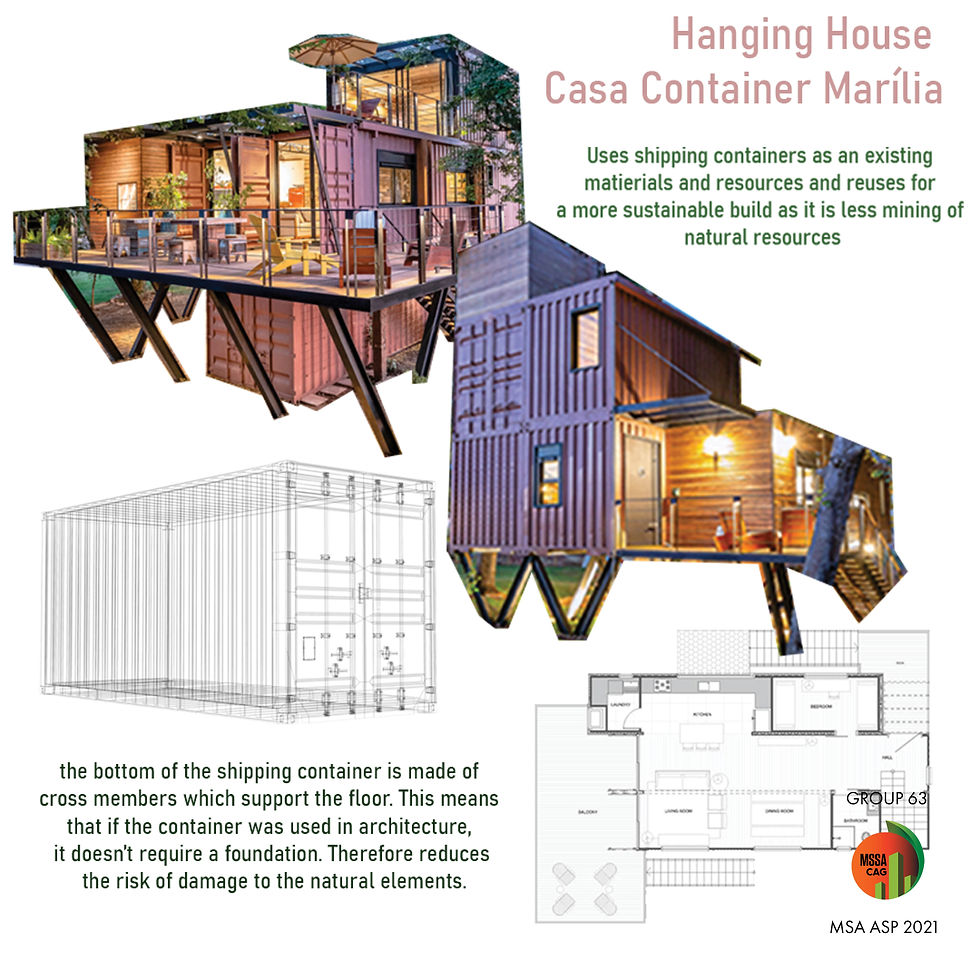
Recycling - Hanging House / Casa Container Marília - Daniel Assuane Duarte
By using shipping containers as a building material ensures less mining of natural resources. The shipping containers are made from Corten steel, also known as weathering steel. This means the containers will rust minimally even if the paint chips.
The bottom of the shipping container is made of cross members which support the floor. This means that if the container was used in architecture, it doesn’t require a foundation. Therefore, it reduces the risk of damage by the natural elements.
Moreover, the floor is made from bamboo. The number of containers that use bamboo flooring instead of marine plywood has been steadily increasing, thanks to lower costs and greater availability. Bamboo is mildew resistant, very durable, and a renewable resource.

Materiality - Sleeping huts for orphans in Noh Bo, Thailand - Tyin Tegnestue
These sleeping huts for orphans were created with locally sourced materials, building techniques and with the help of the community. Bamboo is found in close proximity to these huts and therefore is the primary material used in the construction. Techniques such as weaving are common to this area and is seen throughout the structure, this allows some passive ventilation which is needed in this climate. In addition, larger and stronger bamboo trees are used for more significant roles such as the floor and doors. As well as this, elements such as the roof are thought of as sustainable tools and enables natural ventilation and rainwater collection.

Water Underbelly – Pearl Academy of Fashion, India - Morphogenesis
The building is located in Jaipur, India. The average temperature in Jaipur is 25.1°C meaning thermal consideration is largely required
The underbelly creates microclimate as shades water below which lessens evaporation and aids evaporation cooling.
The water underbelly uses idea of passive cooling, the water evaporates, absorbs heat and helps cool both the building and the underbelly. At night it dissipates the heat to surroundings and keeps the building thermally comfortable.


Comments