
Group 39
- Feb 15, 2022
- 4 min read
An ever-increasing matter rises in the fundamental practices of architecture: the environmental rectitude of rudimental building methodology. As architecture proved to conceive a unilateral relation with its natural environment throughout history (the act of building perceived as destructive consumerism), it became
clear that the human agency was the variable that needed to be changed.
Conscious decisions need to be taken at a macroscale in order to prevent further disruption in the fabric of nature. To us, architectural sustainability deals not only with technological solutions but with a more general sense of responsibility towards the communities and the people it gathers. Pragmatic usage of already locally existent resources could bring lasting results and so, incentives to pursue an ecological agenda. Corporate architecture takes the lead and involuntarily sets the standards of modern building methodology. The ecological criteria started off as an eccentric practice but now, a rapidly growing interest is shown by the wider public.a movement which should find its roots in the fundamental practices of modern architecture.

One Angel Square Building
The 15-storey building is a three-sided structure, with a fully glazed double skin façade that curves both horizontally and vertically around the building. There is a full-height atrium at the heart of the triangular building, its three sides formed from white-painted concrete balconies at each floor level. Behind the balconies there are large, column-free open-plan office floors. The double-skinned facade and an open creating natural heating, cooling, and lighting. The atrium fills the building's interior with light, and the facade helps minimise heating and cooling loads. louvres at the top of the facade will open to allow the warmed air trapped between its inner and outer skins to exit out of the building in the summer. In winter these louvres close so the facade can form an insulated cover around the building.

The vertical forest project
designed by Stefano Boeri Architetti, which will be planted with colourful and scented flowers and herbs. The vertical forest combines balcony greening with high-density unit buildings to make the city more resilient and reduce energy waste. The Plants naturally absorb CO2 and fine particles that pollute the atmosphere in cities, giving out oxygen and creating microclimates that can be healthier for residents. My collage focuses on the expression of the sustainable development value of vertical forests. I simplified some of the existing urban planning into black and white metaphors, and added some surrealistic imaginations. This highlights the effective response of such construction methods to climate change.

Primary School in Gando
The project depicted in the collage is the extension to the Primary School in Gando by African-architect
Diébédo Francis Kéré. The whole project aims to insert a new volume in the existing area of the village as a
response to the rising demand for children to attend the local school. This project conveys local labor and
materials, as well as simple but efficient design solutions, to maximize the efficiency of the building in
terms of climatic sustainability. The particular feature of this building is without doubt the design of the
roof.
The ceiling of the Extension was designed as a singular vault. The monumental vault was constructed with gaps within the weave of the brick pattern of the ceiling. This 'breathing' surface draws cool air from the windows into the interior space and allows hot air to escape through the ventilations, all while remaining shaded and protected. I think this project demonstrates the ability of an architect to create innovative solutions based on tradition but most importantly to educate a community to the principles of built environment and how architecture should not only be sustainable but also responsible.

Plan B Guatemala
This project represents an immediate humanitarian action in the light of the disaster caused by the Volcán de Fuego eruption in June 2018. As hundreds of local families remain without a home, the housing units designed to act as shelter proved to be a remarkable piece of engineering. Cost-effective and easily assembled, the design focuses on the inhabiting programme. The house promotes a rural lifestyle, where displaced families can enjoy a sense of community. This is one of the reasons for a design with an open facade aesthetic, which in turn provides a more versatile use of the space. It also allows for the local lifestyle and customs to prevail and be passed down through the next generations. The use of concrete blocks were at the time an immediate solution which frankly brought the flexibility of a vertical growth if ever needed.
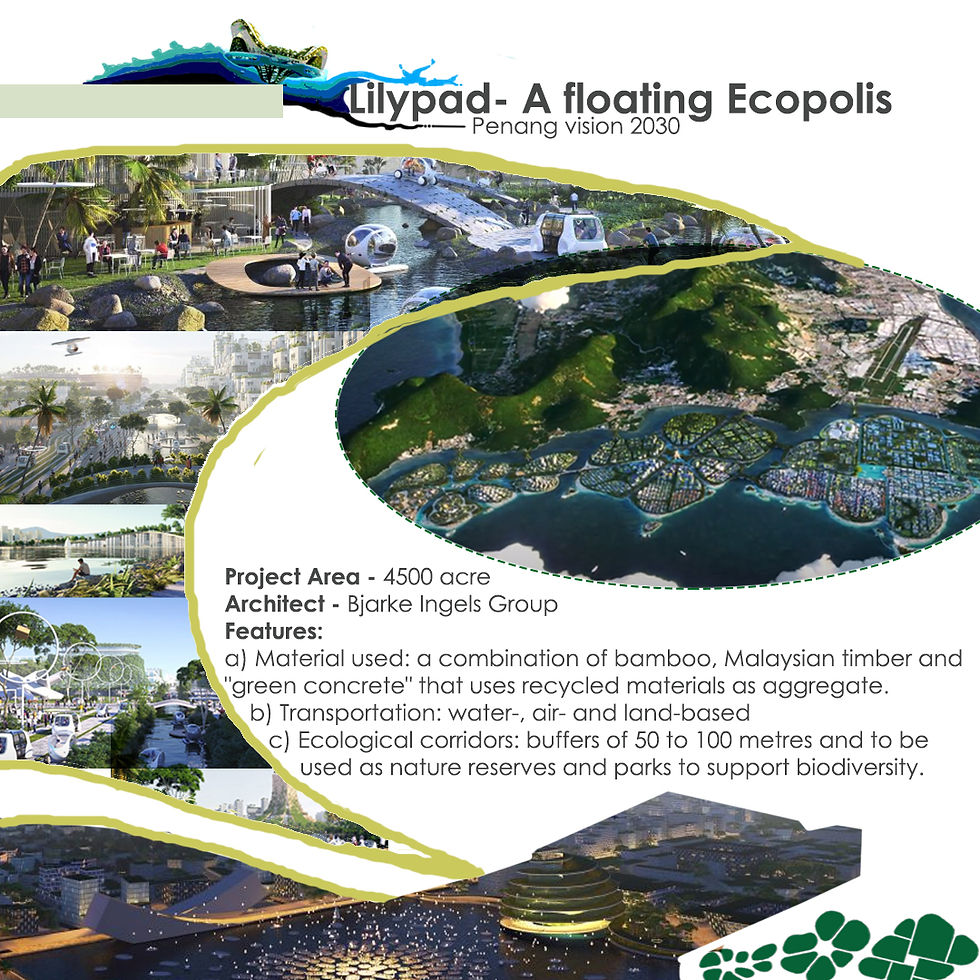
Lilypad - A floating Ecopolis
With ever rising anthropogenic activities, the world is facing the global warming leading to the ocean rise leading to significant loss of available land. In such a crisis which involves ecological death and overpowering microbes. This floating Ecopolis aims to grant the housing of future climatic refugees of the next submerged ultra- marine territories such as the Polynesian. This project is envisioned by Bjarke Ingels Group, spread over 4500 acres, and consists of three urban lily pads consisting of urban districts connected by natural patches and corridors for habitats. This is therefore, a true amphibian structure-half aquatic, half terrestrial, inviting and allowing the biodiversity to develop its flora and fauna. One of its most peculiar features is that that it envisions to create a harmonious coexistence of the Nature and the Built. The three islands together will be all car-free with streets safe for cyclists and pedestrians. However, there will be air, water, and land-based autonomous public transportation available.


Comments