
Group 22
- Feb 8, 2022
- 4 min read
In order to promote sustainable architecture, we should also focus on large corporations as they play a big role in spreading the use of sustainable practices as they have larger impacts and power than individuals and small businesses. Therefore, petitions of the public and raising awareness of more eco-friendly options to these corporations, which may not be as sustainable, can result in more effective and wider solutions.
As communities, we should emphasize on infrastructure in cities, encouraging the well-structured circulation of transportation and sufficient spread of the green spaces within the built environment, to avoid any unnecessary energy waste and unhealthy environment. Lastly, it is crucial for everyone to be aware of the climate crisis we are facing now and educate each other on the issue while taking action.

Charging Stations
Architecture Studio 'Cobe' designed two charging stations for electric cars in Denmark. The design is structured with Timber.
This project looks at modern gas stations and characterises them in terms of noise, odour, and commercial neon signs. Cobe created a design that incorporates only the use of natural materials, natural daylight and recharging the batteries of both humans and cars.
The structure utilises triangular geometry thus providing shade, however, the spaces in between triangles also increase airflow which can be useful for high temperatures. The place not only serves as a charging station but also a shelter for the public from the sun. Climate suggests there is a significant amount of rain thus the vegetation on the roof can be grown.
The swing installations are a good way to keep children entertained. The blocks allow people to sit and relax and compliment the surroundings.

Alternative to Concrete
Concrete is among the largest pollutants in the building industry. Production of concrete emits large amounts of carbon dioxide, thereby perpetuating global warming and intensifying the weather conditions it was created to shelter us from. Over time, the utilization of concrete has become an epitome of development, with countries like Japan and the US primarily relying on it to build ever taller buildings.It is important to end this cycle, and a possible solution is using sustainable alternatives.
Glass Fiber Reinforced Concrete can serve as a more eco-friendly alternative to traditional concrete. The material consists of concrete, sand, and glass fiber, making it easy to mold into various shapes and produce thinner and lighter structures.
3D printing of concrete can be used as a method to create hollow structures and reduce unnecessary concrete use.
Another example is KnitCrete technology at the Museo Universitario Arte Contemporaneo. This technology eliminates part of the waste in transportation and can be used to create very light structures, thus minimizing the overall use of concrete in the structure.
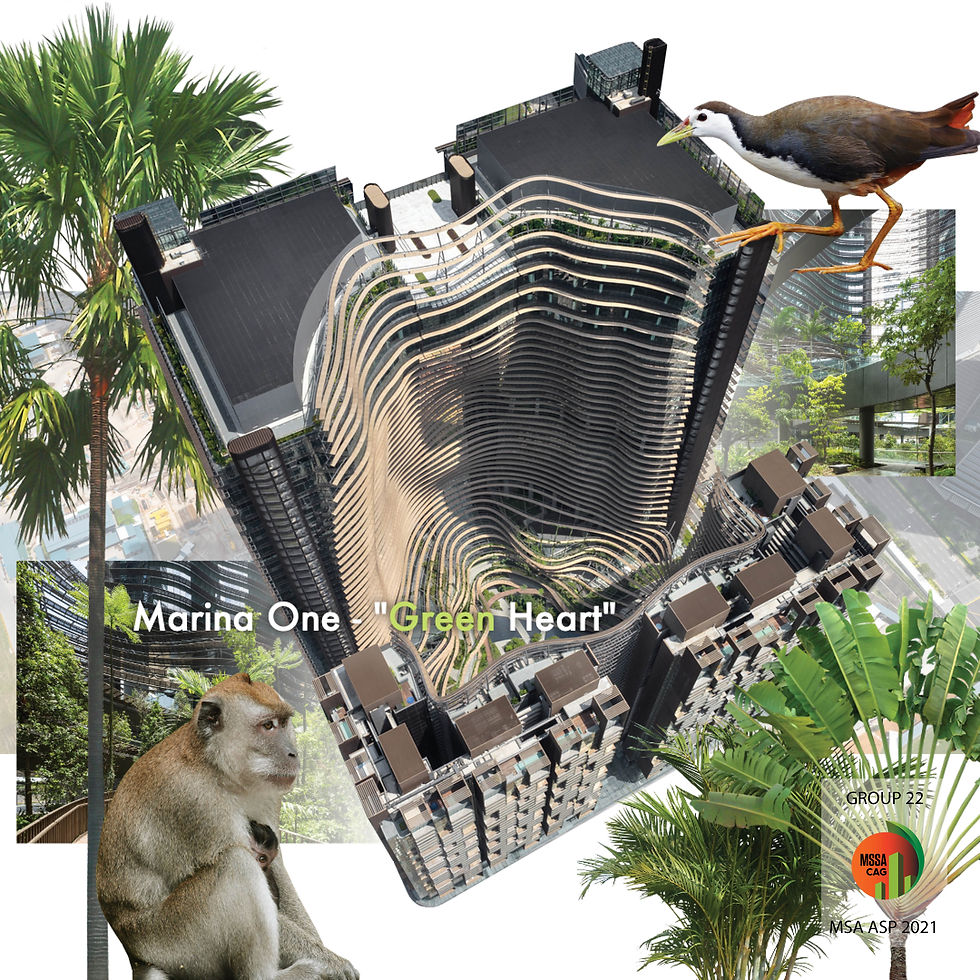
Green Heart
Lying at the centre of Marina One, Singapore, is its “Green Heart” – A tropical forest brimming with life. Designed by Ingenhoven Architects, the forest spans several stories, filled with over 350 different types of trees and plants, including 700 trees. The diverse range of flora helps to create the building’s own microclimate. This man made rainforest in turn provides habitats for various local species of animals, improving biodiversity and allowing life to flourish. The “Green Heart'' also provides spaces for users of Marina One to be close to nature, which would have a positive impact on the health and mental wellbeing of the community.
In addition, the garden combined with the form of the building encourages air flow and improves natural ventilation throughout the entire compound, reducing overall energy usage of the building.

Museum of Tomorrow
Sited by the waterside in a port area that had been abandoned for decades, the Museum of Tomorrow in Rio de Janeiro claims to explore the relationship between the city and the natural environment and features a sustainable design in its various features.
The building has a cantilevered roof with large mobile ‘wings.’ The structure can expand almost to the length of the pier it’s built on. This emphasizes the museum’s ‘connection’ to the bay.
The museum’s sustainable cooling system uses water from nearby Guanabara Bay to help regulate temperatures inside the building; this source also supplies water for the museum’s surrounding pools.
Energy comes from solar spines (photovoltaic solar panels) on the roof, which helps power the museum. The adjustable spines optimize the angle of the sun rays throughout the day and generate solar energy to supply the building, thus taking 9% of the museum’s energy from the sun.

The Voxel
The Institute Advanced Architecture of Catalonia
The Voxel is an abbreviation of the word ‘volumetric pixel’ and it is a timber quarantine cabin, located in Collserola natural park, that was built as an experiment to respond to the 2021 pandemic. The cabin’s purpose is to allow a single occupant to self-isolate for 14 days within the 12 metre-squared footprint.
In its construction, with its modular timber walling system made from timber sourced up to a kilometre away, it lasted for short 5 months with minimal carbon output.
CLTs are used in its walling system for its isotropic and thermal insulation properties.
The sunscreen around it is made from cork produced during CLT production.
The cabin is physically isolated from electricity and water network, so its rainwater collection system and solar panels allow the cabin to be self-sufficient, while the roof planters were added to minimise its carbon footprint or become carbon negative.


Comments